OUR MUSIC
Kamal Al-Mousa
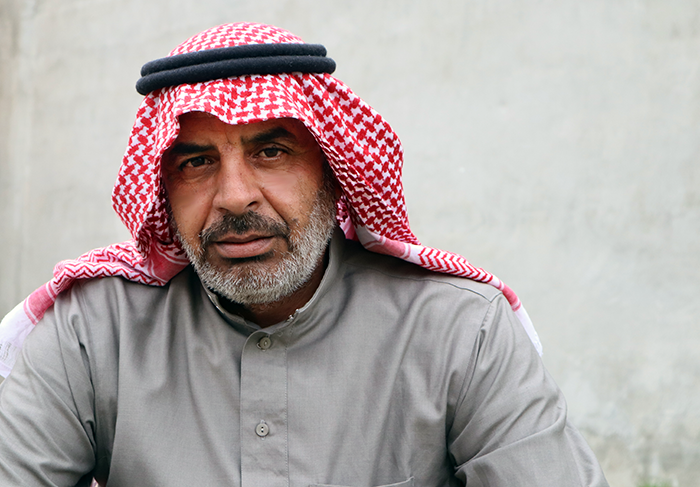
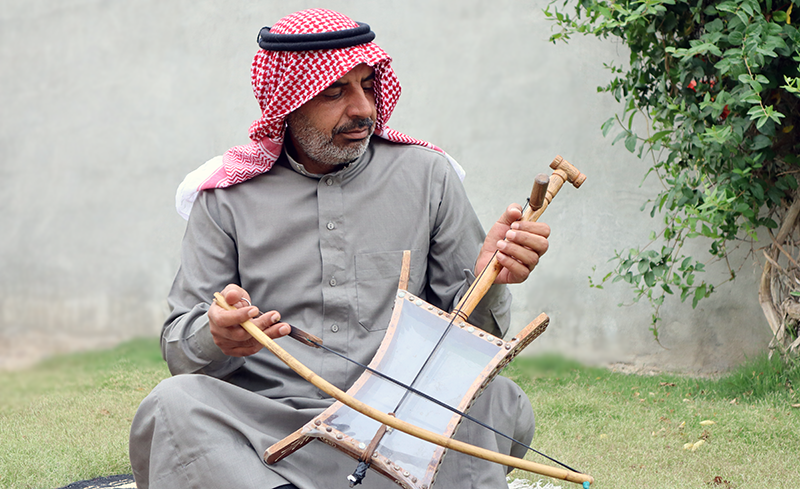
In this episode, the artist Kamal Al-Mousa talks about his beginnings in the practice of folk music, as his siblings and friends supported him for his beautiful voice and his ability to sing Kamal began listening to traditional songs and attending concerts that were held in the city of Raqqa, and his love for the rababa increased.
Despite his strong desire to sing with them, he could not because they were masters of the art of traditional singing Kamal tells us his story and his quest to get his own rababa, where he begins his artistic career and his passion for learning to play. He prefers Swehly because it touches the beautiful aspects of his heart. Kamal participated in the concerts of the Cultural Centre in Raqqa, but he is facing difficulty in practicing art in the current circumstances and the difficult economic situation of the country and the city of Raqqa.
The ataaba is an art form that is recited and sung. It consists of a complete comprehensive literary event, story, news or a philosophical idea and provides a full picture, presented within the very limited space of four lines of poetry. In the picture the ataaba is performed by the singer Kamal Al-Mousa while playing the traditional instrument called rababa.
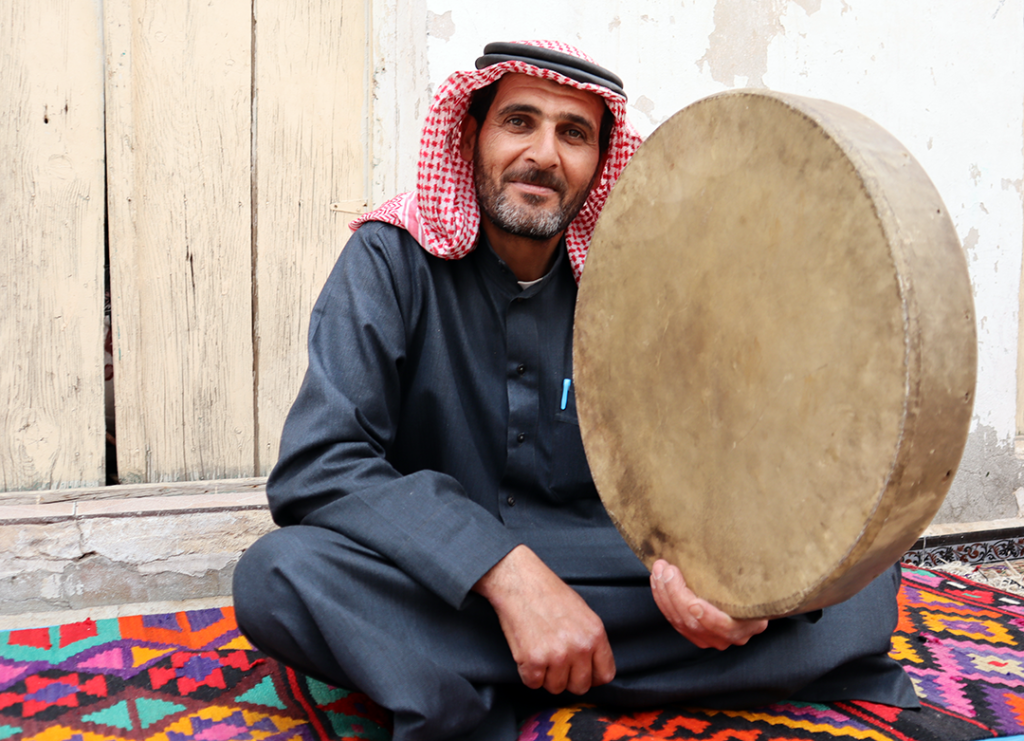
Mahmoud al-Hassan sings a number of traditional Euphrates verses, then he talks about the Rababa, which is his favourite musical instrument, then he talks talking about how he started learning playing on Rababa and how much time and effort he had to learn so that he became proficient and able to play the hardest musical types. Then the artist moves to talk about the different Euphrates musical styles in Raqqa and enumerates them one by one, then mentions his favourite verses of poetry, the reason for his preference for them, and his story with these verses, then he talks about the closest style to his heart, which is the Nayil of Mizmar.
The Nayil belongs to the eastern region’s (Euphrates) lyrical art forms. It is mainly used to express sadness and other feelings like loss, loneliness… even when it sung with rhythmic accompaniment and a relatively fast melody.
The structure of the Nayil appears to be derived from the Mawwal. It has a structure in which the first two lines have the essential quatrain structure of the Mawwal but is distinguished by its slow and sad beat.
Mawwal is a popular genre, with many forms and names depending on the area it is used in, or the sentiment it conveys. It is sung in a single voice with an improvised melody. It can also be composed with a fixed melody made up of static musical song forms such as Ataaba, and Mijana.
Some parts of the songs are accompanied by a single string instrument as the Rababa, Oud, Violin, or wind instruments such as different types of flutes including the Nay, Mijwiz, Duct flute, and Munjaira.
Mahmoud Hussein Al-Hassan
Aboud Al-Shawakh
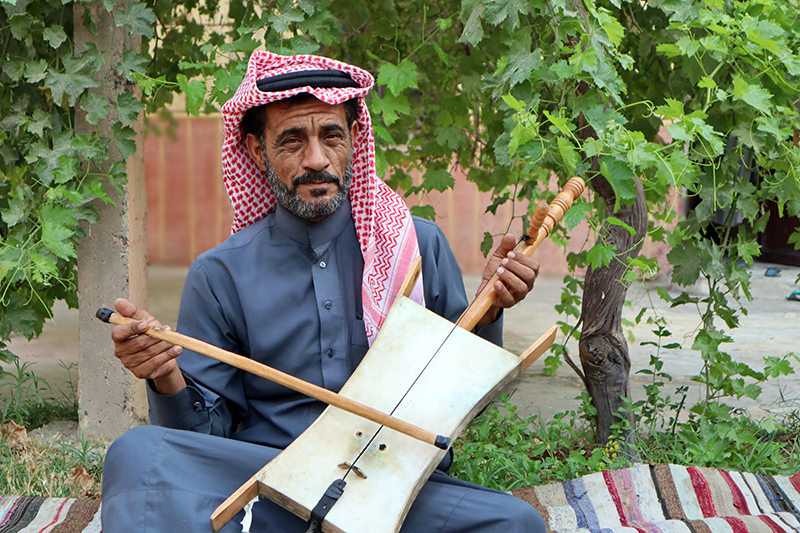
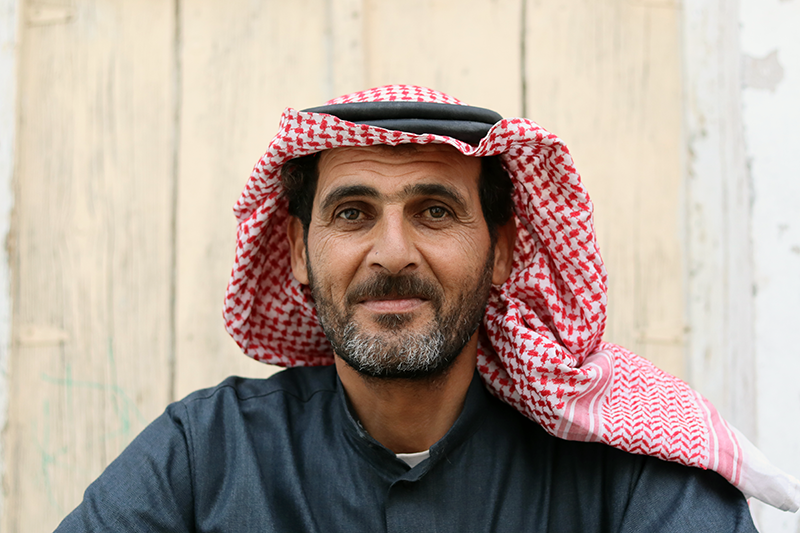
Aboud Al Shawakh was born in the city of Raqqa in 1969. He talks with praise of the old generation of artists in the city, and how he was influenced by the artistic heritage since young age, his love for playing the Rababa. His talent in playing this instrument made him stand out as one of the youngest musicians in the city of Raqqa.
It seems as Aboud connection with the Rababa is a truthful manifestations of how community in Raqqa is connected with their oral and cultural heritage despite of the economic challenges faced by local artists.
In the interview, Aboud also shares with us how he started playing the rababa, how he learned it, and how the opportunities afforded him to participate in public concerts at the Cultural Center in Raqqa.
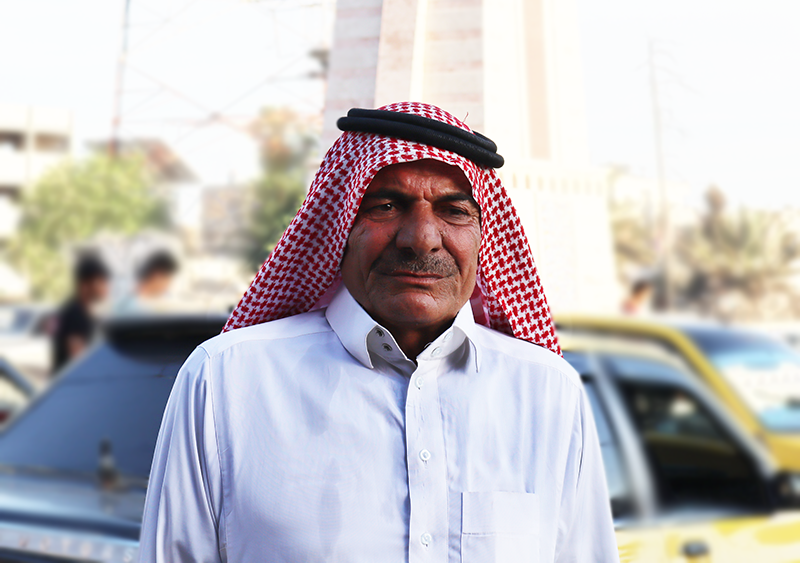
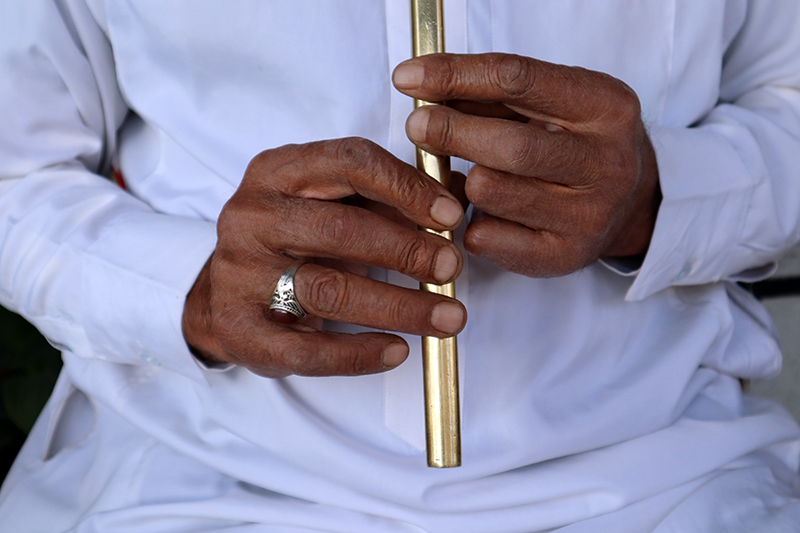
Ali Sanad Al Bakkar was born in Raqqa city in 1962. He tells us about his artistic beginning when he got interested in poetry and artists how he learned of them. He also speaks about the Mizmār, his favourite and describes its beauty and harmony with all types of traditional music in the Euphrates region.
The usually standing player holds the body of the mizmār with both hands so that the reed is entirely inserted into the mouth cavity and the lips press against the top of the pirouette. The thumb and first three fingers of one hand operate the thumbhole and the top three finger holes; the four fingers of the other hand are used to cover the bottom four finger holes, leaving the thumb to help support the instrument. With all finger holes covered, this mizmār produces approximately a G4 (it has a range of about two octaves). The mizmār is a melodic instrument, its player rendering existing tunes or improvisations set in melodic modes called maqamat (sing., maqam) in the Arabic tradition. The scales of maqamat utilize intervals not found in the Western equal-temperament system. An extremely strong airstream is required to make the reed speak, which contributes to the robust sound and high dynamic level of the instrument. The cyclic breathing technique can be applied by players when rendering particularly long phrases.
Ali Sanad loves the traditional music and he performed at the cultural centre in Raqqa and the Radio and Television Department on the Euphrates River where he could play Mowlaya with dabkeh dance which made him famous.
He speaks about his participation in the Syrian series which were filmed in Raqqa city, and he expresses his gratitude for this interesting experience.
The last years were not easy to live, according to Ali Al Bakkar, where he was sick so he couldn’t play in Mizmar, also because the country suffered some difficult times. Nevertheless, he had the determination to stay in his home and encouraged people around him to stay for love and peace.
Ali Sanad Al-Bakkar
Dindar Fesel Husen
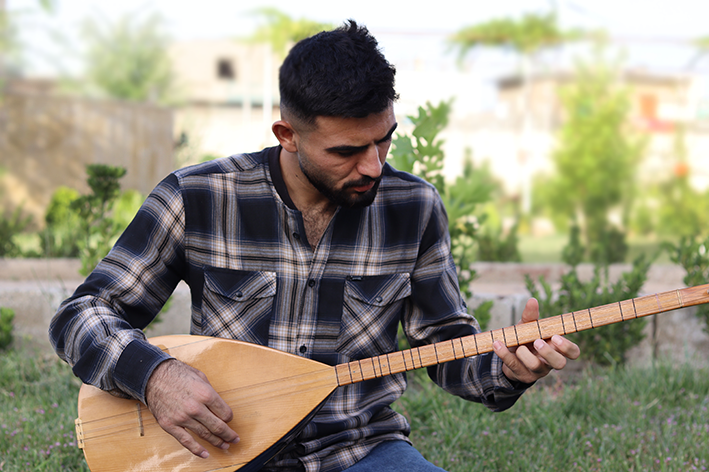
Dindar Fesel Husen is 20 years old and lives in Kobanê. He is currently studying law at Al-Sharq University. He hopes to become a human development coach.
He started playing drums at the age of 15 and loves singing, reading books and playing football.
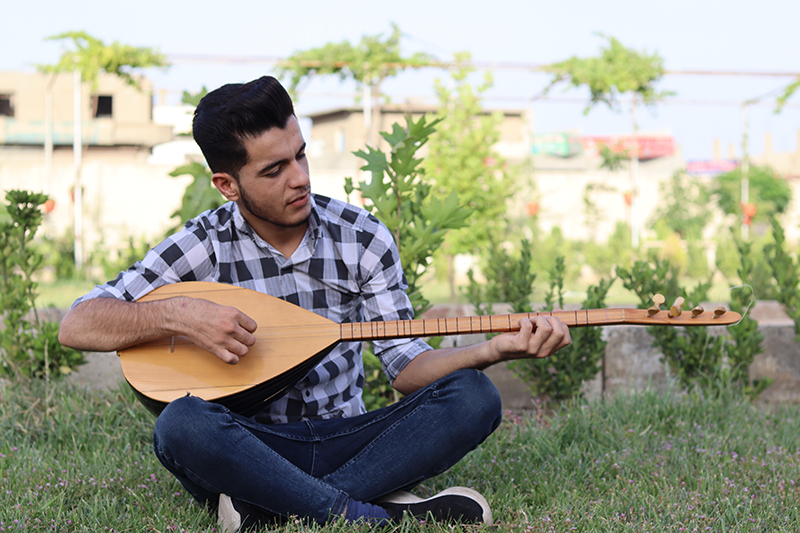
Bozouk and other musical instruments originated from ancient times in Persia. Unlike the short-necked uncut oud, the buzuk has a longer neck, a smaller body and frets attached to the neck, which can be adjusted to produce microtonal intervals used in many maqams (musical modules). Typically, it offers a metallic yet lyrical resonance with two courses of metal strings played with a plectrum. Some instruments are three-course and have up to seven strings in total.
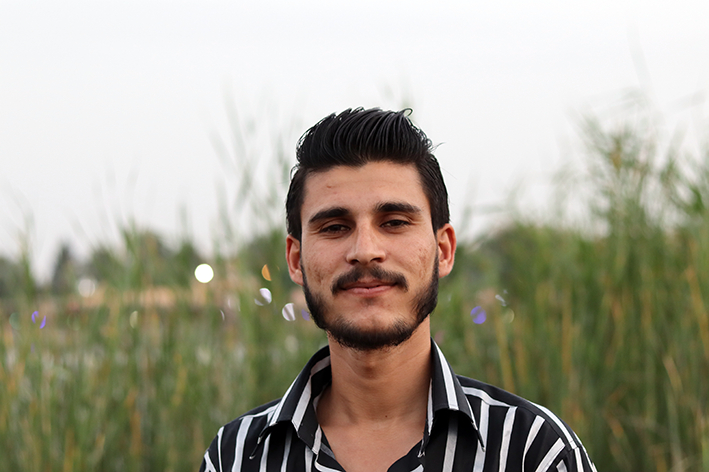
Aymen Mihemed Ahmed was born in Kobanê. He is 21 years old and currently studying computer science at East University.
Eymen started singing at the age of 10. He likes melancholic songs and hopes to learn to play the classical guitar. He likes the song Khazala Xealat by Shvan Parwar.
He played the song:
falls on the roof
The roof of the house looks like a soul, a soul
My patience, my Kurdish daughter, gave me medicine, gave me medicine, gave me love.
I went to the city under the shade of that tree under the shade of that tree he said, who was kidding, cruel, enemy, enemy, traitor, traitor.
Aymen Mihemed Ahmed
Shirin Muslim
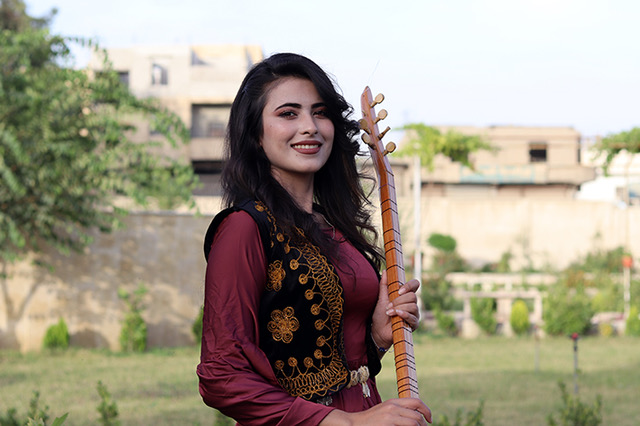
Shirin Muslim is 20 years old and lives in Kobani. She studies biology at the Faculty of Science at Al Sharq University.
She started singing since she was a child and found encouragement from her parents. She did not receive any music lessons, but she receives full support from her family, which encourages her to continue singing.
The residents of her city tend to use buzuq as it is part of the Kurdish heritage, but Shirin prefers guitar.
Sherine is good at singing various types of romantic songs. Her hobbies include drawing, writing poetry, and doing cinematic makeup. Her message to women: Do not let anyone stand in the way of achieving your dreams.
My name is Shiyar Khalil Shikho, and I am 19 years old. I was born in the city of Kobani, and I am studying financial management skills at East University. I started singing when I was 15 years old, and I look forward to learning to play the guitar in the future. I love sad songs, and I enjoy singing, playing basketball, and running.
I dream of becoming a businessman in the future, and I believe that financial management skills will help me achieve this dream. I aspire to build a bright future and to be successful in the business field. I work hard to achieve my goals and develop the necessary skills for success in this field.
Shiyar Khalil Shikho